
Image
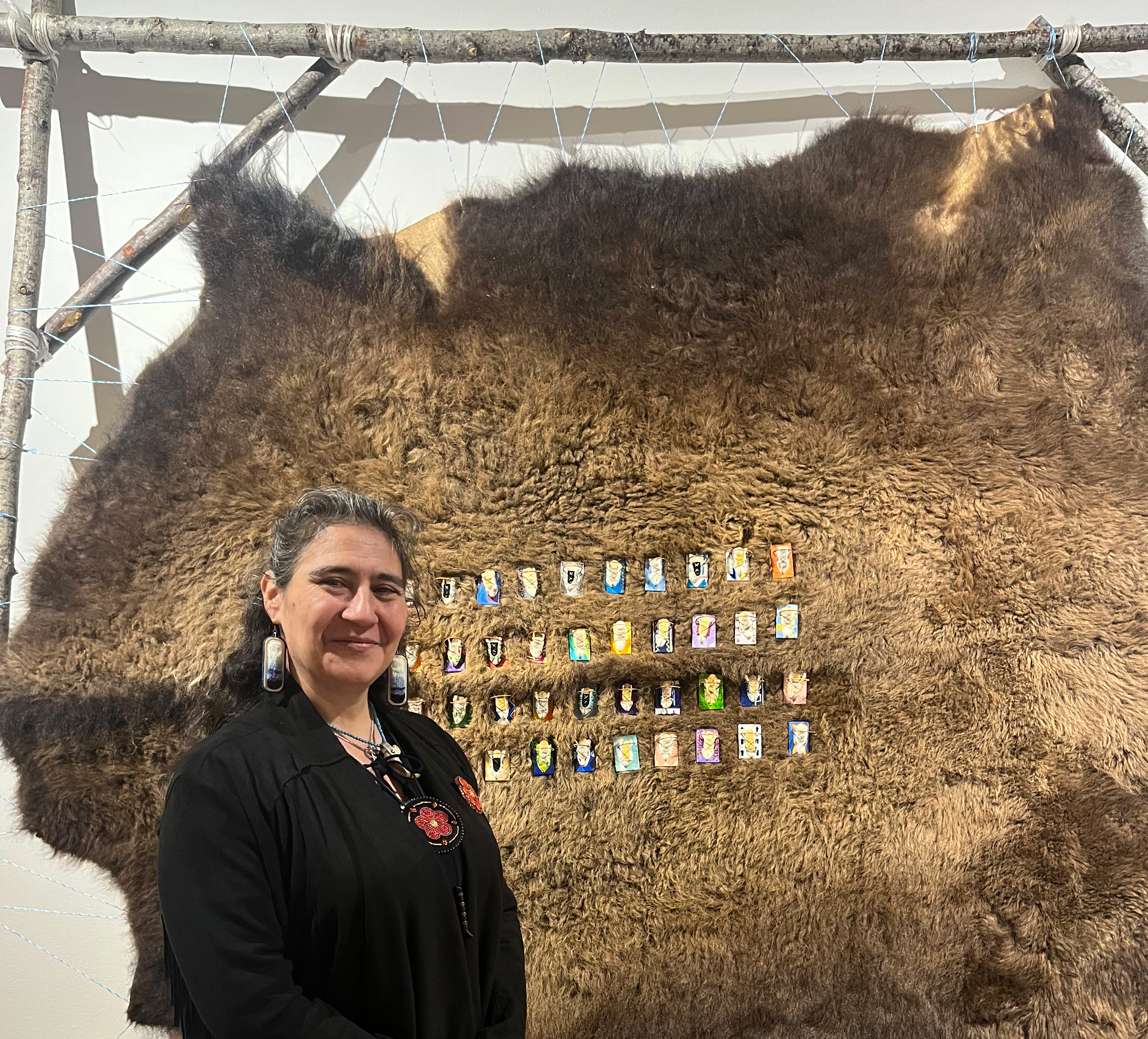
Image Caption
Local Journalism Initiative Reporter
Windspeaker.com
When she heard in 2021 that the findings of an investigation indicated the presence of 215 potential burials at the site of the former Kamloops Indian Residential School in Tk'emlúps te Secwépemc First Nation, B.C., Adele Arseneau decided to move into action.
The Métis multidisciplinary artist created 141 miniature cradleboards that would represent a school named in the 2007 Indian Residential Schools Settlement Agreement.
The result of that work titled wîskwêpitâkan: sacred bundle is now on display in Toronto at the Tangled Art Gallery. It runs until July 17. Arseneau, who lives in Duncan, B.C., first displayed the collection at Vancouver’s Pendulum Gallery in 2023.
Arseneau first started working on the cradleboards with Xwalacktun (Rick Harry), who is a Squamish master carver. Though she created the majority of the cradleboards in the exhibit herself, Arseneau enlisted others who made a few.
“I started carving all the cradleboards because that's part of my mom's traditions,” said Arseneau. Her mother was Cree with connections to Beardy’s and Okemasis’ Cree Nation in Saskatchewan. Her father was from the historical Métis community of Batoche, Sask.
Arseneau wanted to have a lasting commemoration to each residential school in the class action. “I figured this is going to pass from society's eye fairly quickly because being Native, our issues kind of do,” she said.
Arseneau wanted to do something that people could relate to and was not offensive, but told a story with a kinder, gentler hand.
Each cradleboard, also known as a Tikinagan, is made of alder wood with a willow bush bar. Alder wood is a softwood that naturally grows throughout British Columbia.
“The bush bar is to protect the baby if the bundle should fall over, just kind of like a safety belt,” Arseneau said. “I hand-carved all the backs and then we painted them using symbols from people that she’s had interactions with throughout her life that have history with residential schools.
Then I hand bent all the willow. It comes from a tree in my front yard, which really loved the pruning because now it's humungous.”
Her mother’s father was a residential school survivor and Arseneau’s mom went to day school.
A book accompanies the exhibit, and includes lists of the schools. “And it’s done by province,” Arseneau said.
All of the cradleboards in the exhibit at Tangled Art Gallery are displayed on one of five animal hides.
“My original bison took me two years to tan,” Arseneau said. “And I had it stored. Unfortunately, moths got at it. So, when I got notified of this exhibit, I had to get a new bison hide and I didn't have two years to do it.”
The bison hide used at the Toronto exhibit is a commercially tanned hide.
“I figured I'm going to decolonialize it,” Arseneau said. “So, punched it full of holes and stretched it out on a nice rack and then put my baby bundles on it, and said ‘I'm reclaiming you’ because that was such a big part of our culture.”
Other bundles of cradleboards are displayed on moose hide, a Roosevelt elk, which are only found on Vancouver Island, mule deer from Gabriola Island off Nanaimo, B.C., and a bear hide from Sooke, B.C.
While her exhibit was borne from a horrific era in Canadian history, Arseneau said it is also a celebration.
“Our children are our future,” she said. “And the fact that we can take these cultural skills—hide tanning is now making a resurgence—and it is such a healing activity for our youth,” who she teaches.
“Being able to mentor youth in tanning just really helps them make that connection to themselves, to the ground, to their culture,” she said. “And I like to use a lot of our language when I'm teaching so they get that. And then, they learn about the Tikanagans.”
Arseneau hopes visitors are open to the knowledge she’s providing.
“I'm hoping that they learn a little bit about that residential school is real, that everything that we've been through is real,” she said. “They broke chains of culture, changed up knowledge, our language and everything. And through this, they can see a little bit of what we lost. But we're bringing it back. And that's the joy of it.”
She said it was vital to include animal hides.
“There's that pride in our culture and these are imposing,” she said of the various exhibit backdrops. “Who is ever going to see a bison like this up close? Or a moose? I mean the opportunity to be this close to these animals is something most people in Toronto would never have.”
There’s also an area in the exhibit where one can touch and feel what a buffalo or moose feels like.
“It's very educational,” Arseneau said. “And It introduces you to an experience you may never have in your lifetime otherwise.”
For more info on the exhibit go to tangledarts.org