
Image
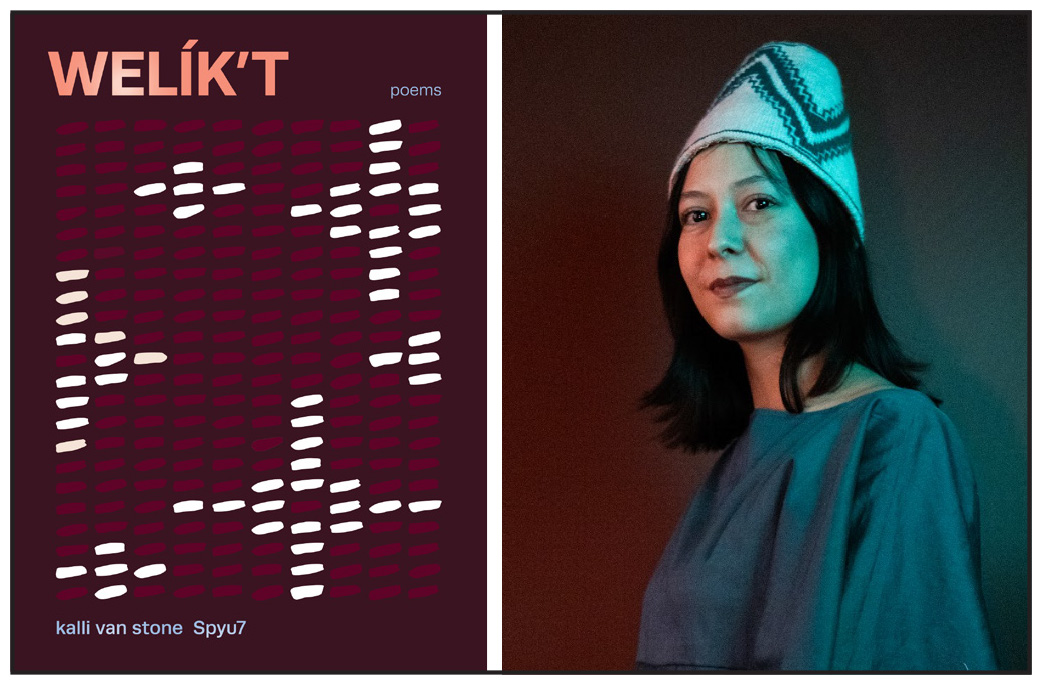
Image Caption
Windspeaker.com Books Feature Writer
Local Journalism Initiative Reporter
“I think the mechanics of (Nsyilxcn and Secwépemctsín) allow me to better express how I feel. English is very restrictive and I feel like our languages are expansive, better able to capture emotions and experiences that I've had,” said Kalli Van Stone (Spyu7) of her first collection of poetry.
welík’t/sparkle contains poems in Nsyilxcn and Secwépemctsín, which are translated into English, and English poems that have Indigenous titles.
In the poem “ʔupnkst uł taq ̓mst skwists iʔ síya/sixteen names of siya?”, which is included in the section entitled “english poems with indian names,” siya (the Saskatoon serviceberry) has 16 names in Nsyilxcn while there are “only a few (words) used to describe it in English and in Latin,” said Van Stone.
“I like highlighting nuances that exist in our language…The language comes from the land. It's not necessarily something people just randomly pick. It's spiritually derived from experiencing the land.”
Van Stone also likes “finding words in our language that really mess with what we know are rules within English and that gives a lot of power to people in a way.”
welík’t is the result of 10 years of work, with about half the poems written in the last two years specifically for the collection. Van Stone said a mentorship enabled her to dedicate time to her manuscript.
The poet explores a number of themes in her multilingual collection, including recognition days like Orange Shirt Day, which appears in “tkwelkwelól ̓ se xéne sitq ̓ t/orange hurt day”; and healing from the intergenerational impacts of residential school, which she addresses in the poem “wenécwem/truth,” writing in the opening lines, “the truths were told/testimony, proof, evidence/wasn’t enough…”
Van Stone also reflects on her experiences in education.
“I spent a lot of time outside or with different parts of nature, so I was inspired by that. And then some of the more new poems are more about embracing our spiritual practices and music and dance to aid with healing,” she said.
In her poem “sumix kaʔɬis/medicine power iii”, she writes, “kʷu ksq ̓ ʷiɬq ̓ ʷɬt/kʷu p ̓ nam ̓ l ̓ k ̓ʷinx/ you do wonders/you bend time.”
“That (bend time) exists in our (Nsyilxcn) language. That's just in our everyday dictionary. That's so inspiring to me. It's so interesting of a concept and it's something that the English-speaking world maybe studies in science now or is really enchanted by in medieval times, but it's not something common today,” said Van Stone.
She also notes that Nsyilxcn doesn’t have many rules when it comes to grammar or sentence structure or verb tense.
Growing up, Van Stone spent more time speaking Nsyilxcn. In the last six or so years, she has learned more Secwépemctsín as both her grandmothers are from Secwépemc. She was raised speaking English.
“There is a different kind of tone and ability I have to...say different things in the English language and that's why I chose a style with my Nsyilxcn and with my Secwépemctsín poems that they're intentionally sparse. I try and work within the limits of my ability to speak in (Nsyilxcn and Secwépemctsín), make them big concepts but in smaller pieces,” said Van Stone. “And then whenever I have a complex vocabulary word, I really like to use that. So they might be sentence structures that are easy, but I like to add complex vocabulary.”
As for translating her Indigenous languages to English, she says it’s “pretty close”, but there are some Nsyilxcn and Secwépemctsín words and concepts that have no equivalent in English.
“But to me, the English is not the important part because we do have a lot of readers and a lot of different people that are learning the language to the point where they don't need a translation,” she said. “So (the English translation) is mostly for making it open to other audiences.”
welík’t/sparkle is published by Nightwood Editions, an imprint of Harbour Publishing, and will be released Sept. 15. It can be purchased at https://harbourpublishing.com/products/9780889715165