
Image
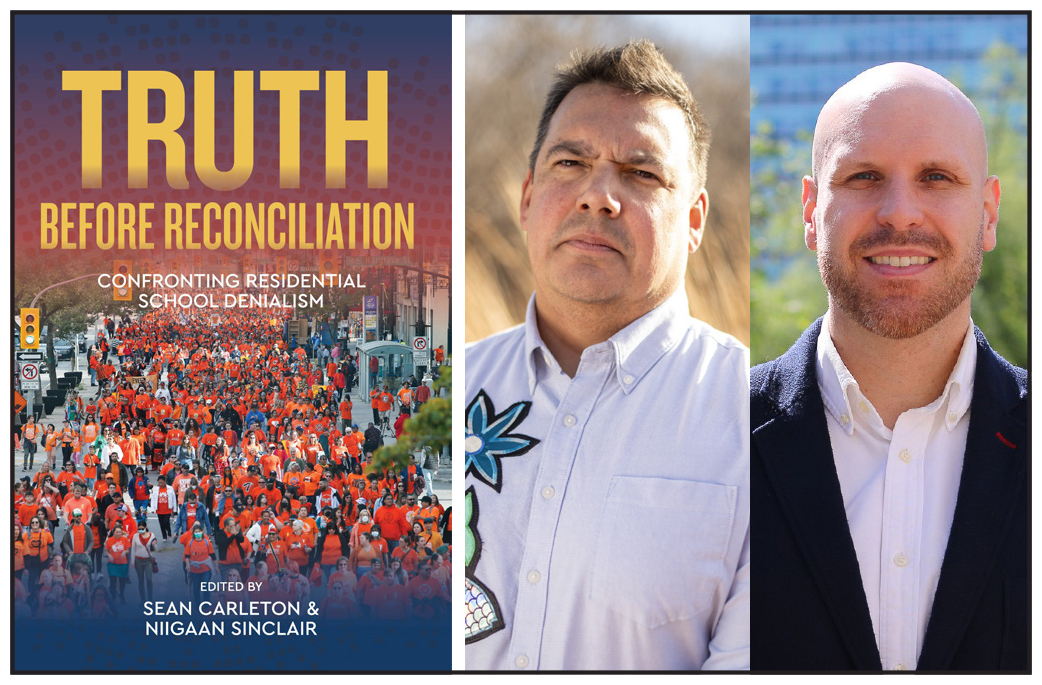
Image Caption
Windspeaker.com Books Feature Writer
Local Journalism Initiative Reporter
The editors of Truth Before Reconciliation: Confronting Residential School Denialism admit they would rather be working with Indian residential school survivors on other issues, but the appearance of a group of masked white supremacists on the Tk̓emlúps te Secwépemc Nation near Kamloops, B.C. make confronting denialism a priority.
“We think of our book like a toolkit. Now Canadians have a toolkit, the voices of survivors, the voices of credentialed researchers,” said co-editor Niigaan Sinclair, Anishinaabe from St. Peter’s/Little Peguis, and a professor of Indigenous Studies at the University of Manitoba.
“Then, of course, all the different ways that we can strategize together to combat what is really a force that's trying to encourage people to be ignorant, encourage them to believe misinformation and lies, and most importantly to be divided. And what we're saying is that we have to come together,” he said.
Truth Before Reconciliation is comprised of essays by and interviews with scholars, historians, other professionals, and residential school survivors.
Sinclair and co-editor Sean Carleton, a settler historian and associate professor of history and Indigenous Studies at the University of Manitoba, look at who spreads denialism and their lack of legitimate credentials; the forms denialism takes; the skewed arguments put forward by denialists; and, most importantly, how to combat denialism.
“I think that the key here is to equip Canadians and also some Indigenous peoples with what is the valid, correct information in relation to these arguments that are being made (by denialists) in bad faith that are based in no research or reality,” said Sinclair.
In 2015, the Truth and Reconciliation Commission on Indian residential schools, chaired by Sinclair’s late father justice and senator Murray Sinclair, released its multi-volume final report, addressing in part the importance of accurate records to combat denialism.
In 2021, when Tk̓emlúps te Secwépemc Nation announced 215 potential burial sites of residential school students on the grounds of the Kamloops Indian Residential School, denialism flared once more.
“A lot of recent residential school denialism has focused on hyper-fixating on the Kamloops announcement and trying to discredit ground penetrating radar and distract people from all of the already existing evidence about disease and death in the system,” said Carleton.
A number of chapters in Truth Before Reconciliation tackles this subject, including an interview the editors conducted with University of British Columbia anthropologist Andrew Martindale. He walks the reader through how ground penetrating radar (GPR) works and what it can or cannot find. Martindale is clear that GPR identifies anomalies that are consistent with burials; it does not identify remains.
“I think if Canadians could just read that and understand what the technology can do, and some of its limitations, we would be further ahead on that specific conversation,” said Carleton. “We wouldn't be asking for (exhumation of) bodies. We wouldn't be asking for these macabre things because we would understand what that technology can help us understand as evidence in relationship to everything else.”
The book also examines the spread of misinformation and disinformation about residential schools globally in the chapter “Exposing Residential School Denialism Transnational Network.”
“In that chapter, you really see how this pernicious mis- and disinformation, this disguised, sometimes very lightly, anti-Indigenous racism is being created and is transporting around the world and is being used to justify colonialism on the global level,” said Carleton, who co-wrote the chapter.
The most insidious aspect of residential school denialism, said Sinclair, is how “people who have never stepped into an archive now suddenly are making big grandiose statements on history…(There’s) the overt, an almost proudness, of ignoring what is now decades upon decades and tens of thousands of pages of legitimate research done in credentialed institutions across the country.”
Both men are adamant that Truth Before Reconciliation is not about giving a platform to denialists.
Carleton notes that ardent denialists won’t be convinced otherwise and that the book is intended for the vast majority of Canadians “in the middle” and willing to learn and are not “distracted by this denialism so that we can all move on with the hard work of building a better world for the future.”
He also points out that his and Sinclair’s decision to focus on confronting denialism instead of debunking denialism “is because all of (the denialists’) talking points have already been rigorously debunked by experts for decades. But it doesn't mean that they are going to not use them as part of this disingenuous strategy to shake public confidence in truth and reconciliation and roll back all of the progress.”
Sinclair stresses that the words of survivors are front and centre in the book, as evident from the opening chapter of an interview with Phyllis Webstad, a Stswecem’c Xgat’tem First Nation (Canoe Creek Indian Band) member. Webstad is the founding member of Orange Shirt Day–Every Child Matters and the Orange Shirt Society.
When Webstad was six years old and on her first day at St. Joseph Mission Indian residential school, she was stripped of her clothes, including the orange shirt her grandmother had bought for her.
“Hearing the stories firsthand from survivors never surprised me, but they do always hurt,” said Sinclair. “The thing that is the most profound is seeing the commitment of survivors, and survivors that are quoted in the essays…to endlessly engage trauma for the purposes of creating something beautiful.”
Truth Before Reconciliation is already in its second printing, largely because of demands from libraries, says Carleton.
“I think it's because denialism is something that a lot of Canadians encounter, but they don't know how to respond to it. And they want someone to stand up to these folks. And this book invites everybody into learning how to develop the courage to do it themselves rather than waiting for the government to do it,” said Carleton.
He noted they would soon be launching Truth Before Reconciliation with the Manitoba Teachers Society and finding ways to help teachers get the information from the book into their kindergarten to Grade 12 classrooms.
All royalties from the sale of the book will go directly to supporting survivors through the Indian Residential School Survivors Society.
Truth Before Reconciliation: Confronting Residential School Denialism, published by the University of Manitoba Press, was released Sept. 9. It can be purchased through https://uofmpress.ca/books/truth-before-reconciliation