
Image
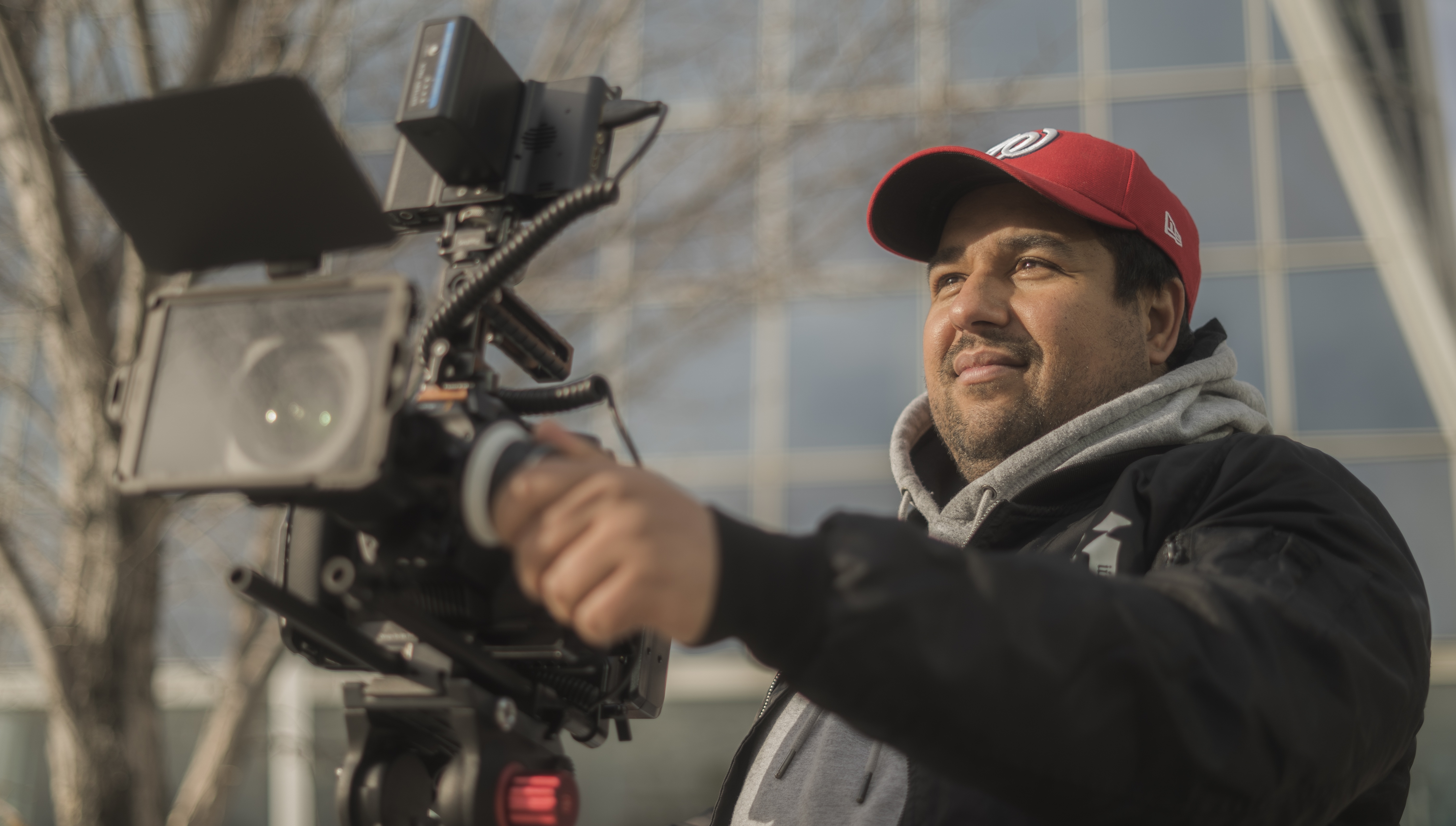
Image Caption
Local Journalism Initiative Reporter
Windspeaker.com
A free online teaching resource called canadianlanguages.org launched Sept. 21 with Nakoda lessons taught by Theresa O'Watch of Carry the Kettle Nakoda Nation. With Cree, Dakota, Dene and Michif lessons already in production, the new initiative aims to break down barriers to learning the first languages in Canada.
While many provincial K-12 curricula across the country now include Indigenous languages, most schools still do not teach them. Founder Wahbi Zarry “wanted to make it so easy for a teacher that there is just no reason left not to teach an Indigenous language in class.”
The Morocco-born certified French teacher developed an interest in Indigenous languages while pursuing a Bachelor of Education in Saskatchewan. Frequently hearing about their endangerment, his award-winning documentaries 10 Days of Cree (2020) and 10 Days of Nakota (2022) sought to show how rewarding it was to learn these languages.
“There are almost no resources when it comes to Indigenous languages,” Zarry said. “At the end, I just said ‘do it yourself and share it with people’. If you keep waiting, then maybe it won't happen.”
Community acceptance has been a prerequisite since the project's beginning. While non-Indigenous people initially warned Zarry that language instruction was a sensitive subject, the First Nations he worked with had the opposite response. Respected Cree teacher and author Solomon Ratt said what Zarry was able to learn in 10 days encourages others to make the attempt.
During the creation of 10 Days of Nakota, Zarry formed relationships with speakers across three Saskatchewan communities. Before proceeding with his idea, Zarry contacted Bob Kowalchuk, Carry the Kettle Nakoda Nation's former director of education, who sent it to local school principal Chad O'Watch. Both language advocates expressed enthusiasm for the project.
According to Statistics Canada's 2021 census, there were only 185 people in Saskatchewan able to conduct a conversation in Nakoda (also called Assiniboine). The total across the Prairies was 325. That year, Nakoda language courses were first offered to high school students in the province, with a curriculum developed by Carry the Kettle (also known as Ceġa'kin Nakoda Oyadebi).
“Since 2021, Carry the Kettle Nation created their own curriculum,” said Zarry. “What's happened in the last 10 years is unbelievable. Fifteen years ago there were 10 or less speakers of the Nakoda language. Now we can say there are 100 to 200 people. When I did my documentary, I was so impressed by the kids interested by their culture.”
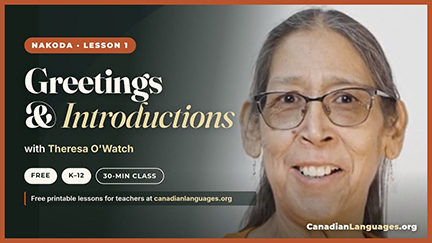
Saskatchewan presently has six Indigenous language curricula at the high school level: Cree, Dene, Saulteaux, Michif, Dakota and Nakoda. The challenge that the Canadian Languages website seeks to address is the lack of teachers actually qualified to deliver these courses. In its Nakoda lessons, Theresa O'Watch will teach the language to both students and their teachers.
“This is extremely important to avoid any mispronunciation,” Zarry said. “The video is 10 minutes but you need to pause it and ask students questions. There's a quiz. The lessons are 30 to 45 minutes, made in a way that the kids will like it. It should be fun or the kids these days don't follow you.”
Easily accessible with no cost or login requirements, each video with English captions is accompanied by a step-by-step teacher guide, student work sheet with seven questions, and a poster with flash cards. In addition to the first video focused on greetings, videos about numbers and family are in production.
Like learning any language, the first lesson teaches introductions that enable students to hold short conversations with a partner. The teaching guide provides expected learning outcomes and suggested responses for students who don't cooperate or even mock the language. In collaboration with O'Watch, the lesson was built around the provincial curriculum.
“Theresa told me to add more listening and speaking,” said Zarry. “Writing comes later because we're talking about an oral language. Spelling is never graded. The student will learn seven expressions. This is just the first lesson. We would like to go deeper.”
Bonding with O'Watch during the making of his documentary, Zarry produced educational videos that she's made alongside her Kushi puppet, a Nakoda word for grandmother. Kushi helps make classes more fun for kids at the Nakoda Oyade Education Centre and is outfitted with clothing from her late sister Freda O'Watch, whose Nakoda name was Pte Hoda wiya (Great Buffalo Woman).
“This wasn't always my journey,” explained O'Watch. “My sister was the language warrior, a fluent speaker who realized our children weren't learning our language. She started revitalizing our language and mentored me along the way. I was asked to fill her shoes and I could never do that.”
While she was born into the language, O'Watch said this connection was lost through residential school and as she struggled with identity issues she turned to drugs and alcohol. To help “wake up the language” inside her, she's been guided by some local Elders and a relative in Montana.
“I've learned within the last 10 years that this language is who I am,” O'Watch declared. “I look around the school at students immersed in culture, with their language embedded in them. Knowing who we are will give us a good idea of where we have to go.”
Describing the Nakoda language as “so endangered that we're down to probably a handful of fluent speakers,” O'Watch said she's grateful for Zarry's platform to document it for the world to learn.
Noting that the language holds the culture's “teachings, values, stories and ways of understanding the world,” O'Watch recalled her mother instructing her to refer to a friend as “cross-cousin female relative” rather than disrespectfully saying the given name. Nakoda is a subject-object-verb language with different phrasings for men and women.
While O'Watch currently teaches kindergarten, Grades 1 to 4 and the high school 10, 20 and 30 classes, she is mentoring younger teachers as she prepares for retirement. As it's an ongoing challenge to find and develop learning resources, expanding the number of language advocates is a priority.
“I can't do this all by myself so Wahbi stepping up like this is an amazing help,” said O'Watch. “As a community, we need to save this language together. I train each of my students to be a teacher to their parents, telling them you'll have a unique superpower if you learn this language.”
Zarry hopes the project eventually features 100 free lessons for every language in Canada, developed in collaboration with knowledge keepers across the country. With 13 videos of O'Watch and Kushi the puppet coming to APTN in December, she's excited that younger generations will have more resources for cultural empowerment.
“So many Elders who went to residential school and didn't think language was important are realizing now that their grandchildren are lacking identity and they want that language back,” said O'Watch. “We have way more resilience than we have trauma. I'm still here. There are still children learning the language.”