
Image
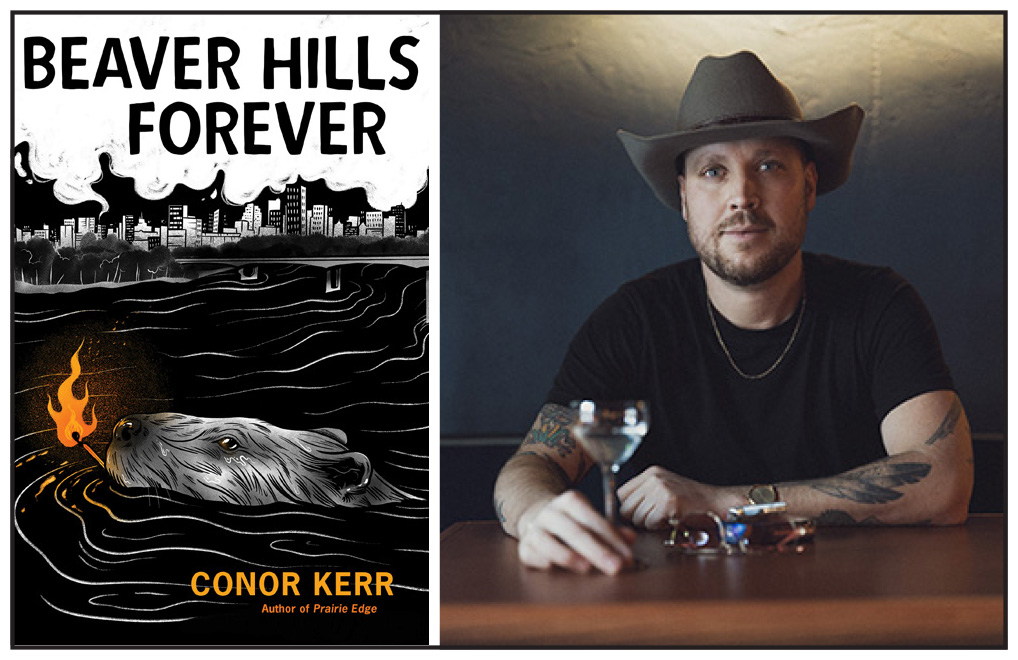
Image Caption
Windspeaker.com Books Feature Writer
Local Journalism Initiative Reporter
It’s no wonder Conor Kerr had so much fun writing his newest book, Beaver Hills Forever. After all, a poetic novella is an uncommon genre and his four main characters, all nameless and Métis, reflect his life and personal experiences.
“To be honest, I was pretty shocked that people wanted to publish it, the book itself, because as I was going, I was having a lot of fun with it. I was, ‘This is ridiculous. This is a novella.’ It's a basically 100-page long poem, but in narrative form, which is also something that people are like, ‘What?' This is an interesting book’,” said Kerr.
Not only did Arsenal Pulp Press publish Beaver Hills Forever, but the book was shortlisted for two 2026 Alberta writing awards. While Kerr, a Métis Ukrainian who resides in Edmonton, didn’t win the Robert Kroestch City of Edmonton Book Prize, he’s still in the running for the Writers’ Guild of Alberta’s Stephan G. Stephansson Award for Poetry, which will be announced June 5.
Kerr is no stranger to literary award nominations. His debut novel, Avenue of Champions, was longlisted for the 2022 Giller Prize, while his most recent novel, Prairie Edge, was shortlisted for the 2024 Giller Prize. His poetry collection Old Gods was a finalist for the 2023 Governor General's Literary Award.
As he has yet to win, Kerr said he keeps his expectations low and “I’ve changed my bio to award-losing author, which I thought was funny, actually.”
While he appreciates getting the critical acclaim, he said “It doesn't really change much for the book itself or the reception of the book in the public sphere.”
Kerr began writing Beaver Hills Forever as a poem when he returned to Edmonton after a short time in Vancouver. He dedicated the book “For Edmonton”, the city whose traditional Cree name is amiskwaciy-wâskahikan or Beaver Hills House.
Kerr has a deep connection to Edmonton, with his great grandmother born in Papachase territory south of Edmonton in the late 1850s. His grandmother told him stories of berry picking in the river valley and “singing out at night from the fiddle music and the drums playing, echoing throughout the” Mill Creek Ravine.
“Those images (were)…so hauntingly beautiful of the space, and what is and what has been here and will be in the future. And I wanted to continue that in the love for a city and the love for that area and space and holding that,” said Kerr.
His characters in Beaver Hills Forever “aren't necessarily straight-up saying something like that because they're not the characters who would. But at the same time, they're existing within this contemporary world that's honouring the city and the space and the lands; lands that their ancestors come from and their families come from and where their kids are going to live for generations.”
Kerr’s initial focus in Beaver Hills Forever was from the perspective of a single character, Buddy, an informal designation. A welder on a pipeline in the northern Alberta oilfield, he reminisces about his grandfather talking about hunting moose as he destroys moose habitat to make money to support his family in Edmonton.
“Buddy’s the blue-collar version of me, basically, where, if I hadn't gone to university or, afterwards, if I had kept going more in the blue-collar fields that my family has worked in, that my cousins, my friends work in,” said Kerr.
It didn’t take long for Kerr to expand his cast of characters.
“Some of the other characters came out based around some of the experiences I had…and I just wanted to keep going with those characters,” said Kerr.
Enter Buddy’s Baby Momma. She’s tired of raising four kids on her own, wants more than Buddy’s money and his idea of a good time at Earl’s happy hour. She wants to show her children what hard work and a higher education can achieve.
Baby Momma, says Kerr, is representative of the students he worked with at the Norquest College Indigenous Student Centre in Edmonton.
“They’re figuring out how to navigate that world when you come back from an extended absence to raise kids and to hang out with your family and trying to better your future and the future of your children by going back and just the struggles and challenges that exist within that world.”
Then there’s Buddy’s cousin, Fancy University Boy (FUB). Successful in his small-town school, his parents and community have pushed him into university. He’s taking creative writing courses, struggling with “how do you fit in when everyone has everything,” as his first poem introduces him. “And all you got is a welder cousin who will throw you/The odd fifty here and there because he feels sorry for/You and you just want to ask him how he can just/Keep his head down and power through all the suck/That he has to go through on a daily?” Eventually FUB drops out and finds his community as a line cook on Whyte Avenue.
“He's the version of me if I actually dropped out like he does,” said Kerr, who has friends who work as line cooks on Whyte Avenue. “I was on the verge of dropping out for many years, but fortunately the creative writing professors that I worked with were very diligent in getting me through at the time.”
Finally, there’s Aunty Prof, who teaches Indigenous literature and is resigned to working in a system that will never validate her. Says her introductory poem, “She got passed up for the promotion again and it’s/Got an eerie ring to the three times that she went/Before the dissertation committee, before they found/Her work compelling enough to put a Dr. in front of her name/And a PhD after it.”
“And then Aunty Prof is…kind of my current version of working as a creative writing professor at (University of Alberta),” said Kerr.
The book is formatted in four sections, with each character’s point of view, interactions and inner thoughts the focus of their own poems.
“I was having so much fun. And then I got this weird format of…four sections, four poems, four characters. And that didn't need to happen. That was just me being, ‘This is kind of cool. I'll do this,’” said Kerr. “I could have just been normal.”
Each section sees each character grow and beat down the negative stereotypes that surround Indigenous people.
“There’s these historical stereotypes around Indigenous peoples, like the absent (parent). That's such a Western racist notion. The vast majority of people that I know and my friends and family, everyone grew up with very loving parents who wanted nothing but the best for the next generations and they set that up, (a) very future-forward-generational-thinking style of life,” said Kerr.
“And I just think that's such a beautiful thing that holds true in, honestly, all communities, but Indigenous ones in particular, and Métis ones in particular, where you're…trying to set up the best for the future in whatever aspect that looks like. I think that's such a beautiful notion.”
Kerr wanted that truth to hold for his characters. In the end, all four characters are on an upward trajectory. While he planned for Baby Momma and Fancy University Boy to find success in their own ways, the crossing of paths of Aunty Prof and Buddy “came up kind of more towards the end of the writing process.” And where that relationship goes is wide open with possibilities.
As Fancy University Boy opines: “Not every Métis kid/Needs a sad story.”
Beaver Hills Forever can be purchased in books stores or ordered online at https://arsenalpulp.com/Books/B/Beaver-Hills-Forever