
Image
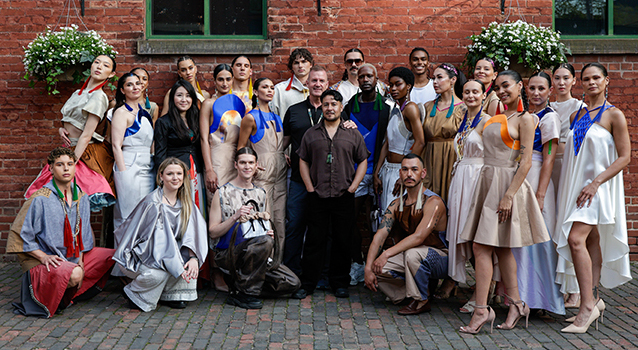
Image Caption
Local Journalism Initiative Reporter
Windspeaker.com
It's been an exciting spring for Cree-Métis artist Jason Baerg, whose newest immersive exhibition of visual art is titled aen nistwayr mayshkotoonikayhk/First Story.
Its launch in May at A Space Gallery in Toronto at 401 Richmond Street West was presented at the same time his multidisciplinary clothing designs were showcased at Fashion Art Toronto and the Textile Museum of Canada.
Baerg is a visual creator, curator and educator who has pushed the boundaries of Indigenous art in exhibitions around the globe. aen nistwayr mayshkotoonikayhk/First Story runs until July 11.
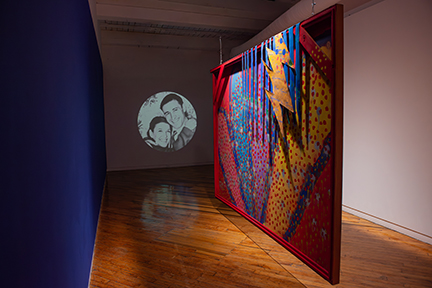
First Story celebrates the healing power of shared family narratives and the deep connections and continuity between memory and place and honours the matriarchs in Baerg’s mother's family.
It takes inspiration from a previous artwork that “dealt with archival images of my great-grandmother and my grandmother,” said Baerg. “For the new work, I took images of my mom and her four sisters, then made experimental short films that were presented directly across the gallery from the paintings.”
A previous collection sparked a powerful response in Baerg's mother, Doris Lanigan, a Senator for the Métis Nation of Ontario, leading to intimate discussions with her and his aunts, the living matriarchs of his Métis family. Their stories directly informed his signature laser-cut paintings, which he began working on during their phone conversations.
Raised in Prince Albert, Sask. with Red River roots, Baerg said First Story is an initial installation of a body of work inspired by family history that will continue to develop following discussions with his uncles back in Saskatchewan this summer.
“It was wonderful to experience life before I was even on this planet as I looked through these images of my mom and her seven siblings in our traditional homelands,” Baerg said. “I believe that patterns reoccur and hopefully we take teachings from the past and advance in new ways as we spiral forward.”
At the heart of the exhibition is a monumental artwork created on a donated frame that once held a painting by Jean-Paul Riopelle, a Canadian painter and sculptor from Quebec who died in March 2002.
Baerg credited A Space for being so responsive to his creative direction, even painting its walls in customized colours. He presented an artist talk on May 22 and was featured as part of imagineNATIVE's 26th annual Art Crawl on June 4.
Over more than 30 years, Baerg has developed an innovative approach to integrating emergent 2D, 3D and fabrication technologies into abstract artwork that often features sculptural textures and vibrant colours. The Cree Medicine Wheel, which represents the interconnectedness of all creation, has been a key inspiration for recent pieces, bridging tradition and modernity through design, materials and symbolism.
“Technology is that space I turn to for innovative articulations in new directions,” said Baerg. “I honour our ancestral artists and their art practices while also trying to bring in something new so it's fresh for me as well as for the audiences. I try to bridge both of those experiences intentionally.”
With his fashion practice, Ayimach Horizons, Baerg brings Indigenous cosmologies and kinship with the land into collections shaped by natural cycles rather than conventional fashion seasons. The newest collection at Fashion Art Toronto (FAT) emphasized sustainability by utilizing only all-natural fibres or recycled materials.
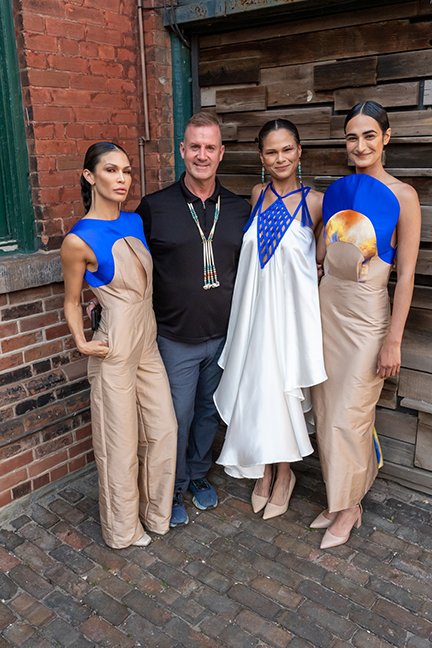
His solo show May 26 was inspired by the rainbow as both cultural symbol and scientific phenomenon. Rainbow, Illuminosity and the Dream unfolded across “four distinct yet interconnected colour worlds” grounded in the inseparability of land, light and identity.
“Some of the form work of the bodices were indirect references to rainbows,” Baerg said. “I constantly get new teachings about the rainbow. It was very intuitive and it just felt absolutely right. When I said yes to it, all of a sudden psychically my dreamscape opened and I was being led through dream world.”
Since releasing a complete collection at Indigenous Fashion Week Toronto in 2020, Baerg's designs have been featured by Vogue and ELLE. He was on CTV's daytime talk series The Social last fall to discuss his experiences at the inaugural Indigenous New York Fashion Week, highlighting Indigenous creatives who have long been overlooked and appropriated.
Recent work completes Baerg's conceptual journey around the Medicine Wheel by embodying the northern quadrant's themes of reflection, renewal and serenity. Light colours evoke winter elements through soft cottons and icy silks, with geometric patterns representing mountainous terrains and frosted surfaces.
Baerg's background in new media and interest in performance art deeply informs the presentation of his designs, transforming the runway into a space where garments come alive. His collections are often a crowd favourite at fashion shows, with Toronto's show attracting legendary journalist Jeanne Beker, best known as the longtime host of FashionTelevision, the first time FAT's creative director had seen her at an event.
“I've been making the laser cuts since 2012 and continue to play around with how this influences shape, colour and feel in the fashion,” said Baerg. “Fashion Art Toronto is always incredible to participate in. I'm so grateful to how they support Indigenous participation, honouring us in beautiful ways.”
Seeking to influence cultural conversations through creations rich in intentionality and narrative, Baerg's unique style can be found in whichever medium he's working in. When producing new work, the artist said he likes to dedicate his “focus on a conceptual space of investigation for at least a year because that allows for cumulative learning to happen.”
Enjoying a windy afternoon in his Toronto backyard, Baerg expressed gratitude for the journeys he's been on and his place within the thriving Indigenous arts scene. As co-founder of The Métis Artist Collective and The Shushkitew Collective, Baerg seeks to empower Métis creators while mentoring emerging talents as an OCAD University professor.
“I find that I keep myself open, teachings come through, people offer generously, people respond and then growth occurs,” Baerg reflected. “I try to share things as I receive them and remain responsive. As new glimmers come forward, I try to weave them into the mix.”