
Image
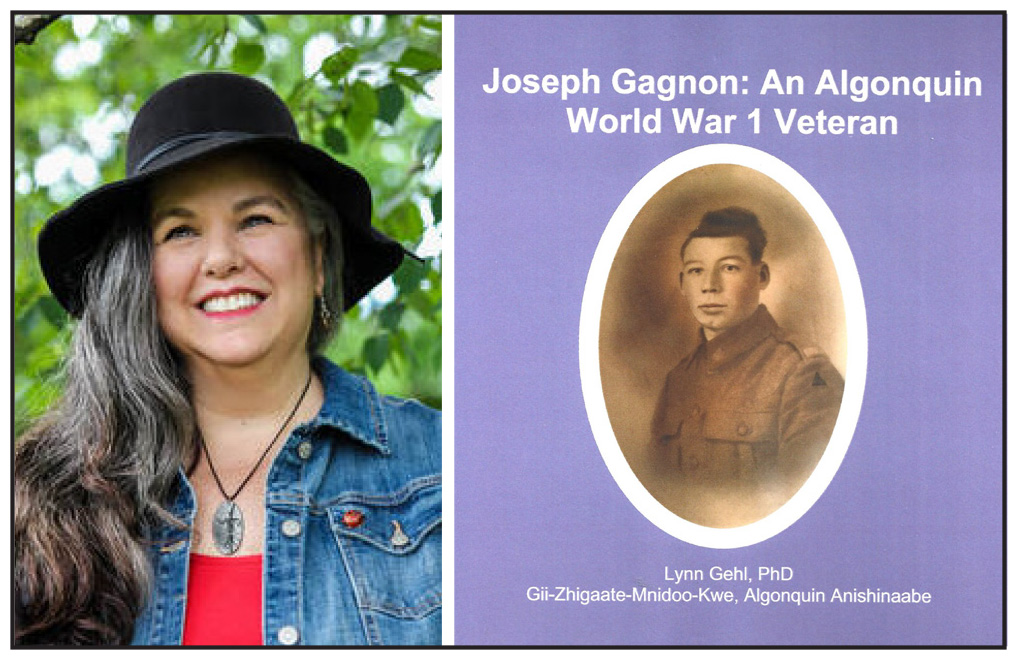
Image Caption
Windspeaker.com Books Feature Writer
Local Journalism Initiative Reporter
Lynn Gehl was in her thirties when she finally started to learn the story of her great-grandfather Joseph Gagnon from Golden Lake Reserve (now known as Pikwakanagan First Nation) in Ontario.
In Joseph Gagnon: An Algonquin World War 1 Veteran, Gehl outlines the way her great-grandfather suffered from discrimination when it came to Canada’s implementation of policies for Indigenous veterans.
“I reconnected with my grandmother and her brother Gordon, and they told me where (Joseph) was buried and they told me that he didn't have a gravestone,” said Gehl.
In accordance with the Last Post Fund, which has been in place since 1909, no veteran is to be denied a “dignified funeral and burial, as well as a military gravestone, due to insufficient funds at the time of death.”
“It just horrified me that he was buried in a pauper's grave. And I carried that. That's what I think is horrible. That's what surprised me that Canada would treat a veteran, a World War I veteran, in that way,” said Gehl.
In 2023, Gehl contacted Veterans Affairs Canada to begin the process of getting a grave marker for Joseph. She managed to confirm that he had been buried in the St. Columba's cemetery in Pembroke, Ont., although the exact location of his gravesite wasn’t known. The Last Post Fund approved Gehl’s request for a grave marker. It was installed August 2024 and reads: “Joseph Gagnon Private 207 BATTN CEF 1888-1939; Valued & Remembered by many Algonquin Anishinaabe descendants. Buried elsewhere in this cemetery.”
Gagnon was one of 29 men from Golden Lake Reserve to enlist. Only 32 men resided on the reserve at the time.
In her book, Gehl outlines how she used family stories and research acquired through an Access to Information and Privacy request to trace Gagnon’s enlistment in 1916 to his return to Canada in December 1918 and his subsequent maltreatment. He returned as a casualty of war, having been gassed and wounded by gunshot and shrapnel.
As a veteran Gagnon was granted the ability to vote in Canadian elections, but at a further cost. His membership in the Algonquins of Golden Lake would be terminated for the privilege.
Gagnon and his family remained on the reserve until 1933 when Joseph needed to claim unemployment relief because his wartime injuries no longer allowed him to work to support his family. However, to get the relief, Gagnon, his wife and five children (the oldest is Gehl’s paternal grandmother) were forced to move from the reserve into the adjacent village of Golden Lake.
It was just one of many ways that Indigenous veterans were treated poorly by the Canadian government.
The 1919 Soldier Settlement Act (SSA) entitled veterans to financial help to purchase a 160-acre plot of land along with farm equipment, livestock, and support for the construction of a house or a barn. However, it wasn’t that straightforward for Indigenous veterans.
“…The department of Indian Affairs administered (the SSA benefits) for Indians. Disturbingly, this extra layer of colonial administration resulted in Indigenous veterans being denied of what they were entitled to, or they were ignored altogether,” writes Gehl.
Indigenous veterans could receive a “location ticket for a lot” on their home reserve, but the land remain owned by the Crown.
However, according to Gagnon’s veteran records, he never received a loan to purchase land for farming, nor did he receive a location ticket for a lot on Golden Lake reserve.
“Indigenous veterans were denied land and land is where privilege is located, right,” said Gehl. “He should have had the right to pass on that privilege of land and resources to his children and grandchildren, and a lot of people don't understand that.”
“That denial of land continues today,” Gehl told Windspeaker.com. Through the land claim process, Algonquins continue to be denied their own land. It's not something that is only in the past.”
In Joseph Gagnon, Gehl lists numerous federal acts that have taken land from the Algonquin people.
In April 2026, the Canadian Armed Forces (CAF) issued a national apology for Racial Discrimination and Racial Harassment against First Nations, Inuit, Métis, Black, Asians and other racialized members of the CAF.
Gehl hopes that Joseph Gagnon: An Algonquin World War 1 Veteran will encourage people to learn more about the Algonquin story.
The book is self-published and can be purchased on Amazon here. Bulk orders can be purchased directly from Gehl at: www.lynngehl.com