
Image
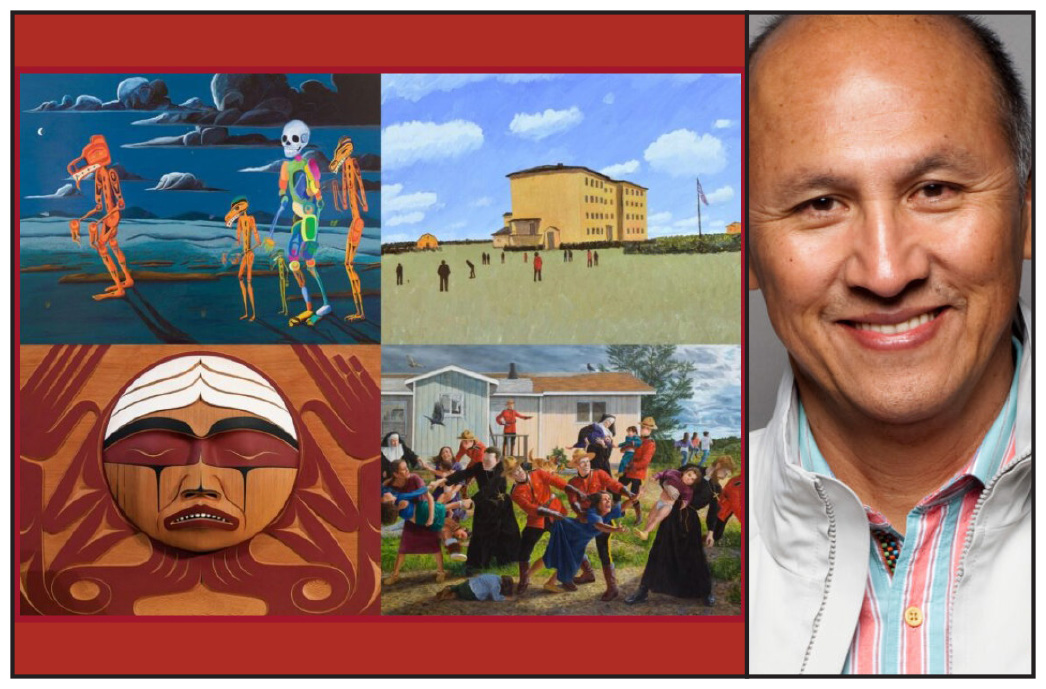
Image Caption
Local Journalism Initiative Reporter
Windspeaker.com
A free digital book that includes the artwork of survivors of the Indian residential school system has been launched.
The book, titled Art, Truth & Reconciliation, was published by Art Canada Institute on Sept. 29, one day before the National Day for Truth and Reconciliation.
The book was compiled by Gerald McMaster, a citizen of Siksika Nation in Alberta, a renowned artist, scholar and curator.
The book features the work of 70 individuals. It is broken into chapters and features the drawings of children who attended residential schools.
Also included is the artwork of residential school survivors and their descendants, as well as Indigenous artists capturing their thoughts on the residential school system.
“My career has been filled with art,” said McMaster, who has lived in Chelsea, Que. since 2022. “And over the past number of years, in advance of writing the book, I have read a number of texts on truth and reconciliation.”
McMaster, who was born and raised on the Red Pheasant Cree Nation in Saskatchewan, had written an essay about his grandmother’s residential school experiences for a book published in the early 1990s.
McMaster said he has often thought about the residential school system over the years.
“When I was approached to write a book by Art Canada Institute, we decided to focus on something like this,” he said.
McMaster said survivors have extensively talked about their experiences in the past.
“There were a few exhibitions, maybe 10-15 years ago, that addressed the residential school period but no comprehensive book that I knew of,” he said. “So, when I started to work on this, I began to discover there was a longer visual history than most people realize.”
McMaster said it was his idea to break down the artwork in the book into three distinct chapters.
“It begins with children's drawings in residential school,” he said. “And then it carried through the many generations of artists responding to residential schools in a number of ways. Some were direct and many were not. But what I found is that they tried to reclaim what the system had tried to be erased, such as their identity, their culture, their kinship systems and their communities.”
McMaster believes publishing Art, Truth & Reconciliation is necessary.
“I think a book like this is needed as well because Canadian art history has also largely been seen through a Western lens,” he said. “And I wanted to bring an Indigenous lens to this project.”
McMaster said he does have a couple of favourite pieces in the book.
One is a painting in the children’s section, which was created by Daisy Lang, who attended the Port Alberni Indian Residential School in British Columbia in the ‘50s and ‘60s.
“Her painting is a very simple one,” McMaster said. “It looks almost abstract. It's of what she calls a beach. So, it's a lot of blues and a bit of yellows in it.”
McMaster said while Lang was in residential school her art teacher did not put any restrictions on the students.
“She painted this beach basically because she said ‘it was our backyard’,” McMaster said. “It was right outside our front door. It's where we went to play, our families went to get fish and crabs for dinner, was a place to swim and to do all sorts of activities.”
Lang’s artwork purposely did not include any humans or housing units. McMaster said Lang explained she omitted these because sometimes bad things happened that she didn’t want to talk about.
“I was drawn to the story of this very harsh reality of how students were treated,” McMaster said.
McMaster also praised the work of well-known artist Allen Sapp from Saskatchewan, who is included in the survivors section. Sapp, a member of Red Pheasant Cree Nation, had attended a residential school in the 1950s.
His painting is called “Recess at Onion Lake School”.
“It’s kind of an exterior photograph of the school itself with young kids in the play yard,” McMaster said. “There's the old British Union Jack, before the Canadian flag, flying in the background. So, he said his own story is that he was never abused in any way as a child. But what he did say is that he remembers that Cree was forbidden, for example. English was compulsory. And punishment was meted out by being isolated.”
Sapp was once caught speaking Cree and confined to his room.
“This was sad for him,” McMaster said. “I think he sat in his room crying because he missed out on a cowboy film. That painting kind of registers that loneliness, the cultural dislocation I think so many kids experienced.”
McMaster said that while Sapp was in residential school his mother’s death was suppressed.
“He was treated that way, not physically or sexually abused, but rather mentally abused,” McMaster said. “To me, that was quite a remarkable painting that I thought was a really good example of someone who was a survivor.”
McMaster, in consultation with the book publishers, put a limit on how many artists to include.
“There's only so many artists I can put in the book,” he said. “But I do have a very good range of men and women and representation from across this country, from coast to coast to coast to border as it were.”
A hardback version of Art, Truth & Reconciliation will be published next year.
McMaster thinks the book will have plenty of appeal.
“I think that it's going to be received in different ways,” he said. “I think survivors, descendants, families and communities, they're going to say that reconciliation has not ended. There's no ending to this. It's not a tidy ending and the story continues.”
McMaster said he’s hoping non-Indigenous readers will look at these works of arts as works of art with stories.
“It tells that art can tell stories that conventional art historical records cannot do alone,” he said. “Art can tell those stories in beautiful ways. But it also can talk about art as a central aspect of Canadian art history.
“We don't think of Canadian art history by looking at residential schools, but it's a remarkable story.”
Art, Truth & Reconciliation can be read here: https://artcanada.com/books/online-books/art-truth-and-reconciliation