
Image
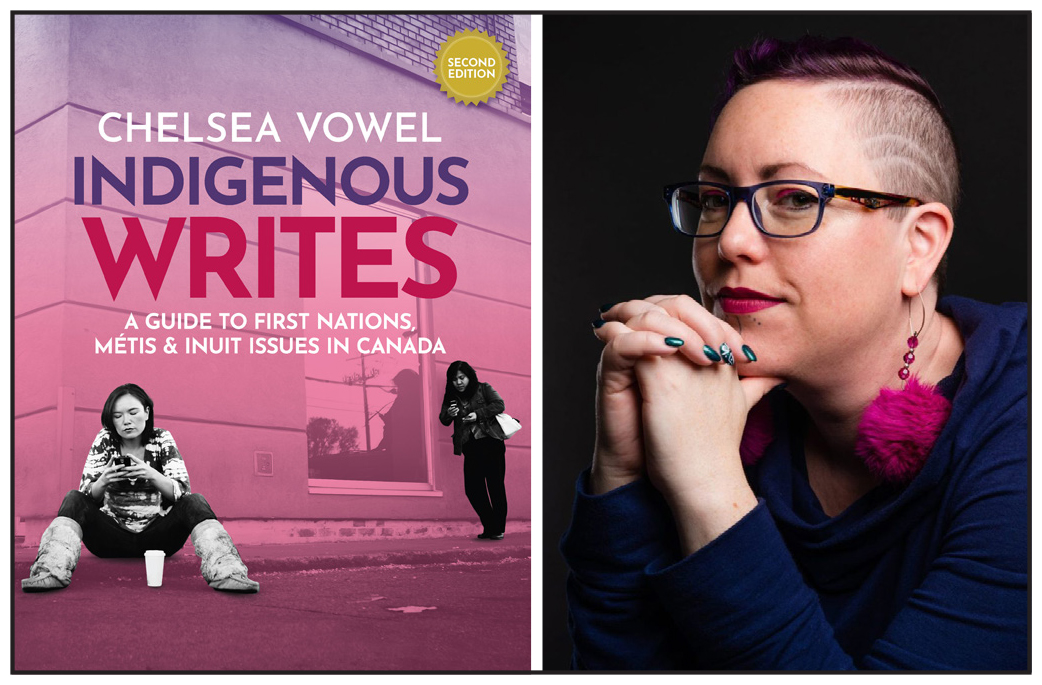
Image Caption
Windspeaker.com Books Feature Writer
Local Journalism Initiative Reporter
The second edition of Indigenous Writes: A Guide to First Nations, Métis & Inuit Issues in Canada will be released in September, marking the 10th anniversary of the original volume.
Author Chelsea Vowel admits that on the strength of the five years of “difficult conversations” that followed the 2015 final report issued by the Truth and Reconciliation Commission (TRC) on Indian residential schools, she “probably naively” hoped that settler and newcomer knowledge about Indigenous peoples would be further along than it is.
The first edition of Indigenous Writes followed a year after the TRC’s final report.
“It quickly became apparent that political will runs everything and however much work you put into that educational push, (it) can be undone,” said Vowel, who is Métis from manitow-sâkahikan (Lac Ste. Anne), Alta.
“I was hoping that at this point we'd be having more detailed and interesting conversations about what are we building now. Instead…I feel like we're spinning our wheels having the same conversations… and the same sort of stereotypes I saw 10 years ago and before that. It's frustrating.”
In this second edition, Vowel has updated the statistics and information on the same topics the first volume tackled, as well as added a handful of new subject areas including Indigenous identity fraud, Indian residential school denialism, cultural appropriation and drinking water on reserves.
The 31 essays in the collection are divided into five subject areas: relationship terminology; culture and identity; anti-Indigenous myths; violence perpetuated by Canada; and treaties and law. Every essay includes an extensive resources list to allow readers to do their own research.
Vowel has “chunked (subjects)…into small increments to not overwhelm people.” She also approaches them as discussions with the reader and employs some sarcasm, some incredulity and some laugh-out-loud moments on heavy topics.
“I find it's hard to have a conversation about these things when all you're doing is trying to create a somber environment where you're haranguing people about it,” said Vowel.
“I'm taking a good-faith approach that I'm being vulnerable and I'm talking about these things (and)…I'm really clear about when I'm biased. I want people to listen to what I have to say but also evaluate it from their own perspective and come at it as a human being and think about their reactions in that personal way. I think that that's how we have these discussions and how they happen best,” she added.
One of the subject areas is entitled “Myth-Busting” in which Vowel dispels myths on, among other subjects, “free housing”, “the Drunken Indian”, and “the Wandering Nomad.”
“It's wild to me that these stereotypes, these myths about Indigenous peoples, are so enduring,” she said. But she understands why they have persisted.
“These colonial myths about us serve a really, really important purpose in forming a colonial identity,” she said. “Myths about Indigenous peoples are predicated on the idea that colonialism happened, parts of it might have been bad, but ultimately it was for the best for everybody because it's a superior system over an inferior people. And whatever topic you want to take, that's at the root of it: It's about superiority over a supposedly inferior people.”
Vowel says such stereotypes impact Indigenous peoples by making them want to deny their identity. The result has been “absolute chaos in our communities.”
“The way that we come back from that, instill that sense of pride and sense of belonging, is to refuse that narrative of inferiority and not by assuming a position of superiority, which is what I think is that colonial fear,” said Vowel. “We just want to not feel like we're inferiors and (instead) feel like we're equals.”
In this edition of Indigenous Writes, Vowel has expanded her target reading audience beyond white Canadians. She also addresses newcomer communities and people who’ve lived in Canada a long time and don’t “necessarily align with the settler state.”
Throughout the book, Vowel focuses on relationships, pointing out that for Indigenous cultures “everything is relational.” Treaties, she said, aren’t a one-and-done deal, but “require constant tending.”
“The problems that we're facing are all about how we relate to one another. And a lot of that relation, a lot of that relationality, is tainted and twisted by hierarchies and stereotypes and racism,” she said.
“Building towards something new…takes all of us working together and speaking together, listening to one another… treating each other as human beings and really, really deeply caring about trying to understand one another.”
In this edition of the book, Vowel’s conclusion offers what she refers to as the “four principles of allyship”: Be guided by your interests and talents; listen to and believe people about their experiences; believe communities have solutions; and, provide the support as an ally that people are requesting.
While Vowel was hoping “to have more interesting generative discussions with people who already know the basics” by this point, she does have hope. She points out that teachers and other professional development groups are “self-selecting into these conversations” and studying and discussing the first edition of Indigenous Writes.
She’s also seen people start with Indigenous Writes as their first reading of an Indigenous author and then move on to other works, fiction and non-fiction, by other Indigenous authors.
“There is definitely a hunger for it and…I feel like the field is expanded and Indigenous peoples are writing in every genre now and to me that's just brilliant. I love it,” said Vowel.
The second edition of Indigenous Writes: A Guide to First Nations, Métis & Inuit Issues in Canada is published by HighWater Press, an imprint of Portage and Main Press. The book can be ordered at https://www.portageandmainpress.com/Books/I/Indigenous-Writes2