
Image
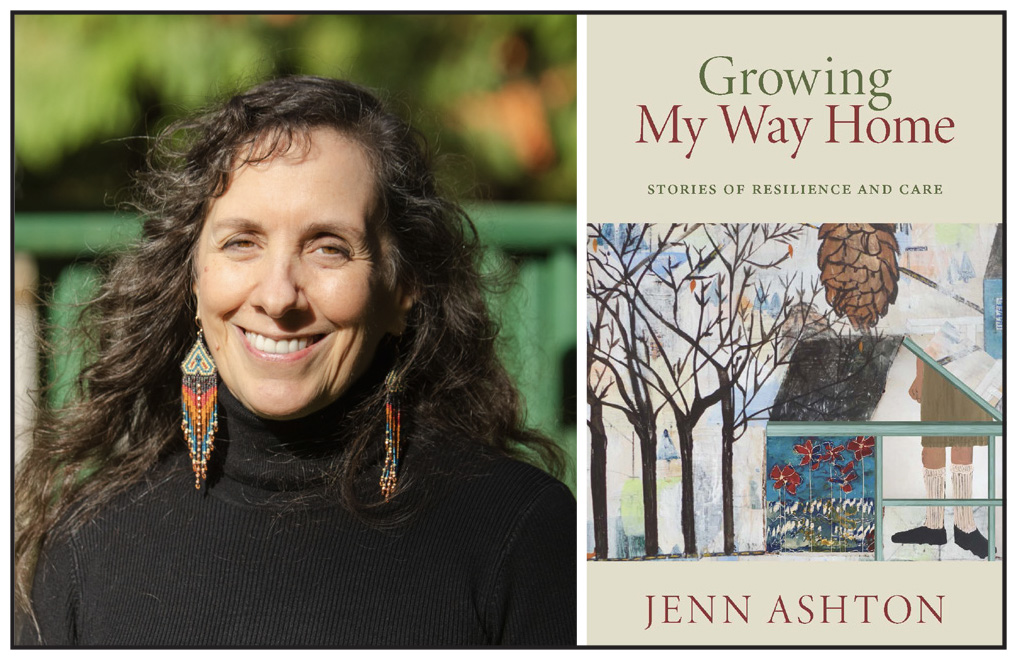
Image Caption
Windspeaker.com Books Feature Writer
Local Journalism Initiative Reporter
Jenn Ashton is clear: Growing My Way Home: Stories of Resilience and Care may be classified as an autobiographical fiction, but it is her true story. The abuse, the time as a runaway and in juvie, the broken marriages, the miscarriages, the drugs and alcohol abuse are all what she lived. The fiction part comes in how she connects the pieces of her life.
“There's a lot of people out there who don't like the term autofiction because it seems like a lie and they don't know which parts are real and which parts aren't. So, I always want to start off by saying the book is real,” said Ashton, who is a "status Indian" with Sḵwx̱wú7mesh (Squamish) Nation in British Columbia.
“Autofiction,” a term coined in the late 1970s, differs from memoir and autobiographies because it blends fiction into reality.
Ashton has been trying to tell her life story for years. Although some of her work has been published as short stories, she didn’t get any bites from publishers when she employed a variety of long prose styles, including creative non-fiction, memoir and journal entries.
Growing My Way Home is “about the tenth iteration” of that process and Ashton says she’s pleased with it.
“I try and measure that against, ‘Am I happy that it's just over? Am I happy that it's finally off my plate?’ Or ‘Am I happy that a publisher finally wanted it?’ But when I got it in my hand and I read it, I was like, ‘Yeah, I'm happy with that.’ I'm happy on a whole bunch of different levels,” she said. “When it comes down to it, it's out in the world and I'm happy.”
Ashton’s daughter and sister were pleased with the book as well. Both play minor roles in Growing My Way Home because, as Ashton says, their stories aren’t for her to tell.
Ashton doesn’t offer her life in chronological order and being First Nations is sometimes vague in the narrative. It isn’t until the end that she’s clearer: “On TV we would watch cowboys and “Indians” and John Wayne and Tonto, but we would never visit Granny, who knew the real Indigenous world. We were told our history, but we could never touch it, and so we watched clean cowboys and troublesome “Indians” on TV and forgot who we were. For 50 years that knowledge sat unmentioned,” she writes.
“I didn't fully understand until 20 years ago," Ashton told Windspeaker. "It was more of a very slow, methodical research, getting to know people, talking to Elders, finding out who my family members were because it's important for us to be able to say who we are and where we come from. I didn't know those pieces all the way along until the end. That was a real awakening.”
That awakening is told in four chapters or four steps which are dispersed throughout Growing My Way Home. The first three steps are entitled “Woman Builds Herself a Greenhouse.” The fourth and final step sees “and Comes Home to Herself” added to the chapter title.
“I think it was a real process of decolonization and decolonizing my mind. Because I grew up in colonized culture that's how I thought, and I think the steps that I went through (were) to...come back to the land where something inside of me was pulling me there,” she said.
Building a greenhouse wasn’t metaphorical. Ashton did build an actual greenhouse.
Ashton tried to grow her plants in the greenhouse before the planting season and ran into numerous problems. In the end, she gradually moved the plants outdoors and put them in the ground.
“When I look back at how my life was, I can see all of the things that were trying to get me back to where I was supposed to be. I think I was trying to have dominion over this place, and it was going to be my redo and I was going to do it right. And when I look at it now, I think, ‘Oh, that is such a colonized way of thinking that I was lord over these plants and everything and making this perfect place for them.’ I was actually shutting out nature in that greenhouse,” she said.
Ashton started building the greenhouse around the same time she started making connections with the Squamish Nation. It was a journey she made with her father, although she doesn’t include that information in Growing My Way Home because her father’s story is not her story to tell either.
In fact, Ashton includes nothing about her research and finding her connections with the Squamish Nation.
“I think that didn't really fit in with the story of the book…I was trying to make it more for a global reader,” she said.
Ashton refers to doing the research and making the connections as her “academic stuff,” which she keeps separate from her “writing stuff.”
“This book is about the decolonization process. It's…about showing that there are a lot of us out there who are in this middle road, who don't know our past and there's a lot of people coming home right now and doing the research and connecting,” she said.
“Coming home is an internal process and you have to get back to the land, and each person will do that in a different way that works for themselves. It's a personal process that everybody has to go through. You can't just show up and say, ‘Here's my status card. My DNA says I'm one of you.’ There's so much more to it than that. I hope that comes across,” she said.
At 62 years of age, Ashton is now working on her Ph.D. through the Edinburgh University of Divinity, studying the aspects of colonization which have helped to dismantle Indigenous spirituality.
Growing My Way Home: Stories of Resilience and Care is published by Talonbooks. It was released in April. It can be ordered at https://talonbooks.com/books/growing-my-way-home