
Image
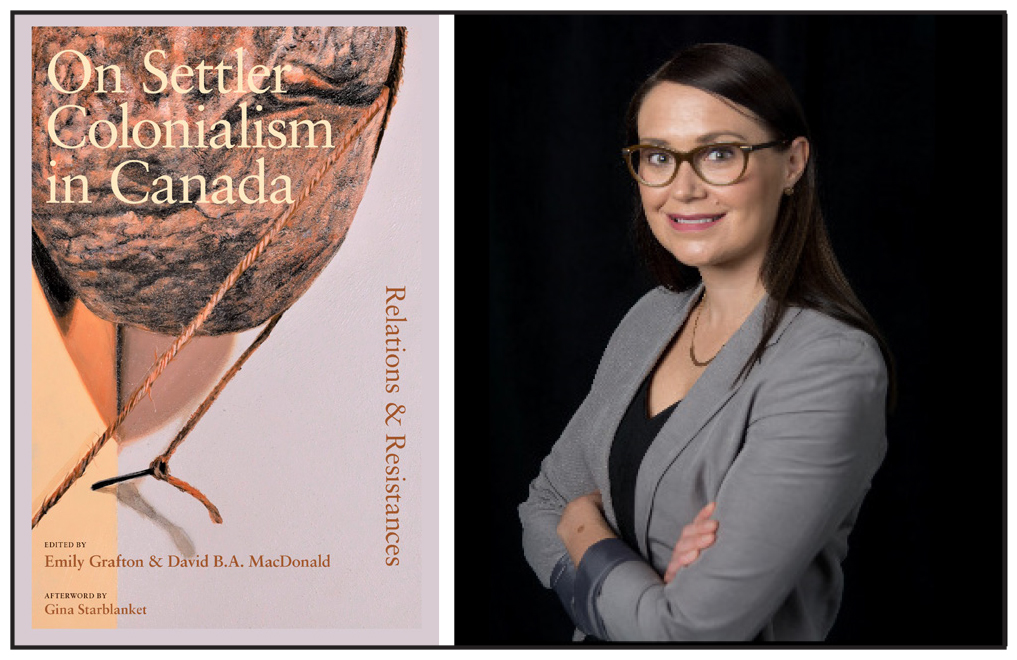
Image Caption
Windspeaker.com Books Feature Writer
Local Journalism Initiative Reporter
On Settler Colonialism in Canada: Relations & Resistances was released in May marking the 30th anniversary of the Report of the Royal Commission on Aboriginal People (RCAP).
“These efforts (like RCAP) seek to address these historical foundations that contribute to ongoing injustices that Indigenous Peoples face as a result of settler colonialism,” write co-editors Emily Grafton and David B.A. MacDonald.
“I'm trying really hard to see the progress,” Grafton told Windspeaker.com.
“We can see moments of progress with the (Truth and Reconciliation Commission), with the Calls to Action and the moments that those are taken up in earnest. Then we need to follow. Does the taking up, does this practice result in some kind of a transformational change? And sometimes that's just really hard to quantify or even qualify. What are we measuring and how do we measure if this is a lasting change or truly transformational change,” said Grafton.
Progress in the past few decades has happened “because Indigenous communities and nations have gone to the courts and used this settler tool to hold the government to account because they weren't being accountable,” she added.
Relations & Resistances is the second volume in the On Settler Colonialism in Canada series.
Contributing writers are Indigenous, non-Indigenous and racialized. They explore reconciliation, decolonialism and resurgence through relational perspectives as a means “to identify potential approaches to addressing, reducing, or overcoming colonial inequities,” write Grafton, who is Métis, and MacDonald, who is an Indo-Trinidadian and Scottish-settler academic from Saskatchewan.
While reconciliation is typically framed between settler and Indigenous peoples, Grafton says that if decolonization is understood to be correcting colonial harm, which includes mitigating land loss through land back, then there is a relational connection with everyone who lives in Canada.
Newcomers to Canada don’t necessarily see themselves as part of the settler versus Indigenous pairing. Many newcomers experience racism, economic marginalization or religious ostracism and don’t believe they get the same benefits as settlers.
“The interesting thing about the literature is that it expands that to a triad or a triangulation of society... Within that, there's all of these experiences of marginalization and benefit…this spectrum (of) dispossession and benefit,” said Grafton. “I think (it) reflects Canada in a way that provides more almost accuracy to how people situate themselves to settler colonial Canada.”
Contributors examined how people come to know and interact with the political systems. They framed how they understood settler colonialism or decolonization or reconciliation in terms of relational values such as community or their ancestors or broader society.
“Do we understand Canada as a collective where we are working towards a shared goal of betterment or are there frictions there within our relationships?” said Grafton.
In his essay “On Codifying the Traditional Laws of Indigenous Nations in Canada”, Leo Baskatawang, an Anishinaabe scholar from Lac des Mille Lacs First Nation, writes: “If the desire to dismantle another nation’s house was there, is it even possible? In Canada, it seems obvious that the state and its institutions, for better or worse, are here to stay.”
In “Rights and Responsibilities: Indigenous Realities, Indigenous Priorities”, Joyce Green of English, Ktunaxa, and Cree-Scots Métis ancestry writes that “Constitutional emancipation is not the experience of Indigenous Peoples in Canada, and inclusion in the settler state and societies is arguably the wrong goal for Indigenous People.”
“I see Leo and Joyce articulating the boundaries of some really important arguments that occur at the kitchen table or in classrooms,” said Grafton, who is an associate professor of Politics and International Studies at the University of Regina. “What's the problem? What do we perceive as a solution? How do we move forward?”
Where it all goes from here, Grafton says she doesn’t know.
“Do we ever fully have a decolonized state? I mean, I don't know. That's a really big question. And I guess I don't know it because there's no kind of evidence or even what are we working towards? Has that dream been dreamt?” she said.
Grafton expects to use the On Settler Colonialism in Canada volumes as university textbooks. The first book entitled Lands & Peoples came out in 2025 marking 10 years since the final report from the Truth and Reconciliation Commission.
She says her students understand and can speak about colonialism, dispossession, assimilation, oppression and liberation.
“But what these books do is they give (them) tools, vocabulary, historical context to analyze and argue and give shape to problems and hopefully also to solutions,” said Grafton.
For many non-Indigenous readers, the books will provide new information.
While the two books are distinct, they do complement each other. Both also have artwork by Governor General award winner and Métis artist David Garneau.
On Settler Colonialism in Canada: Relations & Resistances is published by the University of Regina Press. It can be ordered at https://uofrpress.ca/Books/O/On-Settler-Colonialism-in-Canada-Relations-and-Resistances