
Image
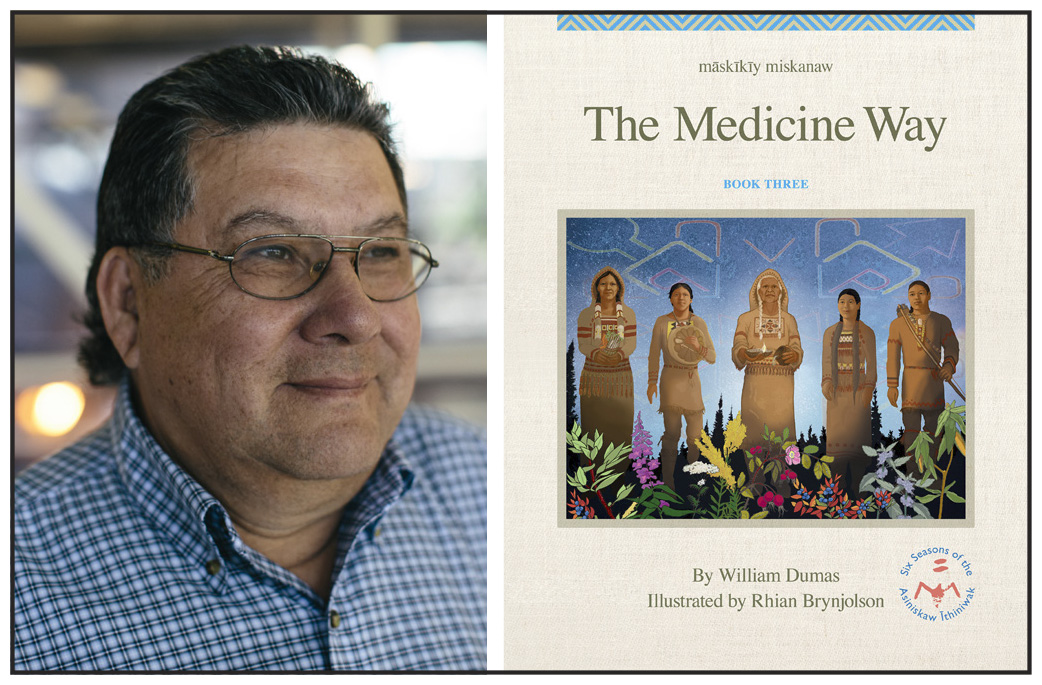
Image Caption
Windspeaker.com Books Feature Writer
Local Journalism Initiative Reporter
Reclamation must come before reconciliation, says Rocky Cree knowledge keeper and storyteller William Dumas, and that’s the reason behind the Six-Seasons picture books project.
māskīkīy miskanaw: The Medicine Way is the third book in the series, which is aimed at reclaiming and revitalizing the asiniskaw īthiniwak (Rocky Cree) language and culture.
“Reconciliation…is a beautiful, long-off dream. We’ll work towards that. But first, reclamation is important for us. Agreeing on who we were by discussing around the table (with knowledge keepers) and then putting the story together,” said Dumas, who resides in Thompson, Man.
The Six Seasons project began in 2008 as a collaboration between Dumas, Rocky Cree knowledge keepers and the University of Winnipeg.
The impetus for the books came with the 1993 discovery of the remains of a young Cree woman in South Indian Lake in northern Manitoba. When the 350-year-old burial site was discovered, Dumas, who was born in South Indian Lake, was teaching in the community.
The Elders agreed to have the remains and site studied. Archeologists and anthropologists did carbon dating and wrote scientific reports.
But that wasn’t enough for Dumas, who at the time was on an advisory committee in the history department at the University of Winnipeg. He heard that Canada Research Chair Mavis Reimer had started the Young People’s Texts and Cultures research centre. He approached her about telling the story of the ancestor as a series of picture books which would reflect the six seasons traditionally followed by the Rocky Cree.
“I thought at the time (that) our language is slipping away, our spirituality is slipping away. How are our children going to survive into the future?” said Dumas, who grew up surrounded by storytellers. “It's beautiful to be a Rocky Cree child. It's beautiful to understand who I am.”
The Medicine Way takes place during the season of tākwākin (fall) and follows a Rocky Cree family preparing for winter as they travel to hunt, gather medicines and learn from their relatives. Young Mwakwa is trying to define the path he will take in life. Through the council of his uncle, he learns a new way of looking at the night sky and travels the path to become a stargazer and storyteller.
Along with Dumas’ narrative of Mwakwa and his family, the book includes what Reimer refers to as “notes” on cultural objects, vocabulary, language, geography and history. The notes are dispersed in boxes throughout the pages.
“When William was telling some of us at the university the story, we kept interrupting him… and we said, ‘What does that mean? Where exactly did this happen?’” Reimer explained about how the notes came about. “As we wrote down the answers that he gave us to the questions…we started to realize that many, many people who read these books will have similar questions.”
To answer the questions, Dumas consulted with Rocky Cree knowledge keepers, including his wife Margaret Dumas.
“I learned a lot from the other knowledge keepers as we went along…just gathering ideas from each other. And even with language, with the words…to discuss one word for 20 minutes, half-an-hour,” said Margaret.
“Research from the point of view of the Elders and the knowledge keepers…is remembering knowledge that they have and the knowledge that fed the community,” said Reimer.
She also points out that the unique style used in displaying the story in book form is akin to how Elders tell stories in a circular fashion and never in a straight line.
“I think we maybe found a form that is actually quite authentic,” said Reimer.
Medicine Way, as well as the second book Amō’s Sapotawan (summer or midsummer), is illustrated by Rhian Brynjolson, who is not Indigenous.
Dumas did not want to use a traditional Indigenous style for the illustrations as that style more often depicts legends. He wanted the story to stand out as history.
Dumas says the books are a “beautiful study” of a cultural background that colonialism tried to shame out of the Rocky Cree people. He wants both Indigenous and non-Indigenous youth to learn from it.
When the project got underway, Reimer says they received funding that she hoped would pay for all six books. However, it took time to build trust and relationships between the university and the Rocky Cree knowledge keepers, who lived in the north.
“So across cultures, across distances, across languages…we've worked hard to understand one another, and in the end, I think that's part of the value of the project too,” she said. “We want to very much make sure that other people coming behind us understand how we did it and really, really recognize the work that it takes…and effort on both sides.”
Both Reimer and Dumas are hopeful additional funding can be acquired to finish the final three books in the project.
The first picture book of the Six Seasons of the Asiniskaw Īthiniwak, Pisim Finds Her Miskanaw (late spring), was illustrated by Mi'kmaw artist Leonard Paul.
māskīkīy miskanaw: The Medicine Way, published by HighWater Press, an imprint of Portage&Main Books, will be released Sept. 15. It is geared to children ages nine to 12 years old. It can be purchased though https://www.portageandmainpress.com/Books/T/The-Medicine-Way