
Image
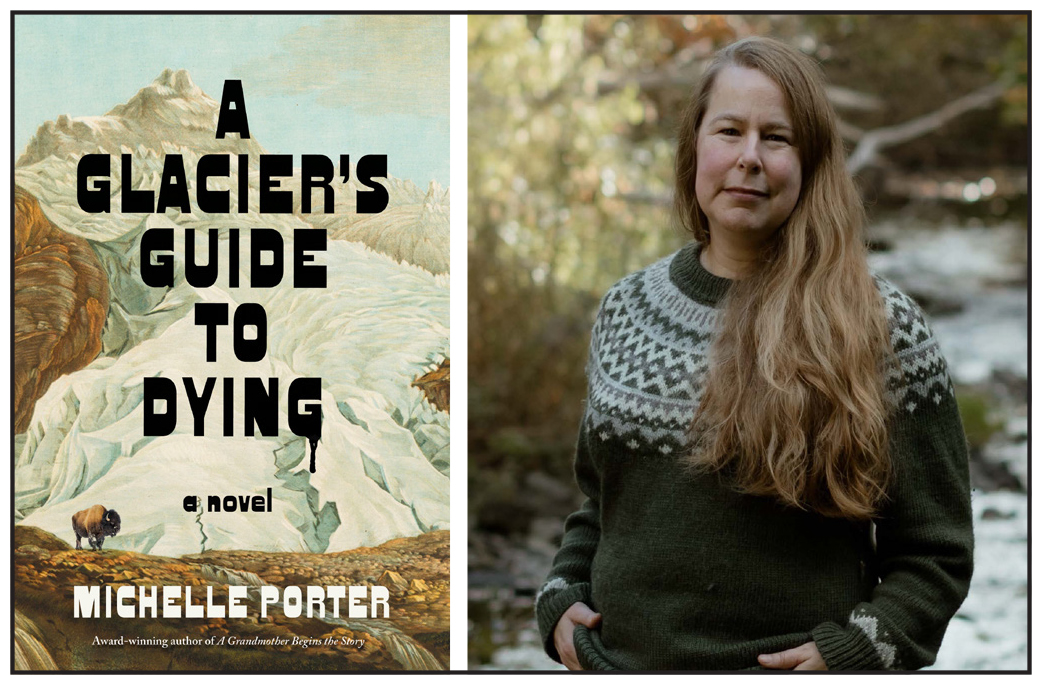
Image Caption
Windspeaker.com Books Feature Writer
Local Journalism Initiative Reporter
Author Michelle Porter says that while she understands how Robbie’s story concludes in her new novel A Glacier’s Guide to Dying, she recognizes that readers may understand it differently.
“The funny thing is, I wrote the book believing Robbie's point of view entirely. So it wasn't until afterwards that I realized it could be read in multiple ways. And I left it that way because that delighted me,” she said.
Robbie comes from a broken, violent home. His stepdad Ray beats him and his mother, who is Métis. His biological father Mike, with whom he shares the trait of one blue eye and one green eye, is plagued by mental illness.
When a wildfire encroaches upon his mother’s home, spurred on by his two sisters and half-brother, Robbie returns to rescue his mom and, in the process, encounters Ray. With his mother safely in his truck beside him, she tells him that Mike is missing. Robbie joins with paternal uncle Doug in Montana to search for Mike and in the process learns that Doug left Mike on a glacier.
But the glacier is much more than the setting for the climax.
“I sat down early one Saturday morning and I came to this title (for the novel) with the idea that the glacier is the central character in the book, even though the glacier is quite quiet in many ways…(and) doesn't take up many pages… What both the glacier and all the other characters are doing is struggling with coping, with experiencing life's transitions,” said Porter, a member of the Manitoba Métis Federation. She now lives in St. John's, Newfoundland and Labrador.
Through various versions of the book, the glacier had different personalities, says Porter. In the final version, the glacier is sarcastic, funny, rude and “very focused on its own process of dying and what it wants to leave behind…It’s not overly concerned with humans. Humans are a little blip in its lifespan and in its sense of its presence on earth. But also its kin. So there's a sense of that family.”
Robbie initially struggles with coping with his father’s absence and then later with the possibility of his father’s death. Meanwhile, the glacier brings “an ageless, a timeless, that ancient perspective on the changes of the seasons. And so there's that wisdom that the glacier offers. And I just, I really liked that focus on the glacier speaking through the novel,” Porter said.
While Doug no longer has cell reception as he and Robbie search for Mike on the glacier, Robbie is receiving constant texts from the glacier. Or is he?
“A Glacier's Guide to Dying can be read in two ways,” said Porter. “If you see mental illness and you interpret Robbie's visions as mental illness, but if you move along with that more visionary side of things and that considers that there are so many things on the earth that we don't understand, don't know are possible…then you see Robbie as struggling with visions he doesn't understand necessarily and having a connection beyond himself to the non-human, to the earth, to the glacier, and witnessing the glacier's last acts before it melts in terms of giving the earth a legacy.”
Porter’s first novel, A Grandmother Begins the Story, won the 2024 Thomas Raddall Atlantic Fiction Award. She says fiction allows imagination to recreate the world.
“For me, fiction has so many possibilities and that's why in my fiction you find things that might seem impossible to many readers to have happened in the real world that actually happened to the characters in the book,” she said.
Porter, who also writes poetry and non-fiction, said her mother reminded her that fiction also allows “hard truths” to be told in a manner that can protect the living and hold on to secrets.
Robbie’s journey mirrors Porter’s in many ways. Her father was diagnosed with schizophrenia when she was a child and disappeared into the streets at various times until finally he didn’t come back.
“This book for me was very much an honouring and an acceptance of…my father's death, even while…there is no body, there is no certainty necessarily behind it. And it takes time and it's a process. But writing this book…one of the gifts for me was the ability to give my father a different ending to the story,” she said.
Porter learned in conversations with Métis writer Maria Campbell and late Sto:lo writer Lee Maracle that the purpose in telling a story is important.
“I realized that we have such a responsibility for our stories. And we have said that, in many ways, you can tell a story with many of the hard details, but if it's pointed in a good direction, you're helping your community, you're helping your family process, you're helping not just yourself, but your people and your family. And it's something I've been learning more deeply with everything I write, and it's informing more and more my direction,” she said.
That is part of the reason the book ends the way it does, Porter adds.
A Glacier’s Guide to Dying, published by Algonquin Books, will be released Nov. 3. It can be purchased at https://www.penguinrandomhouse.ca/books/711055/a-glaciers-guide-to-dyin…